
Not sure if your home health agency needs a 401(k) plan audit? Learn the 100-participant rule, the 80-120 exception, and what to check every plan year.
The payroll report shows 61 employees, and 48 of them have a balance in the 401(k) plan. Another 73 former employees still have a balance in the plan. The participant count that matters for the Form 5500 is not 61. It is 121.
The number of participants with account balances dictates whether a home health or hospice agency needs a 401(k) plan audit.
For a defined contribution plan, the DOL counts participants with an account balance on the first day of the plan year (DOL, 2023 Form 5500 Instructions), and a plan that files as large generally has to attach an independent auditor’s report. At 121, the plan is above the 80-120 range, so it files as large no matter how it filed last year.
This guide walks through the 401(k) plan audit requirements that apply to a home health or hospice agency: how the participant count works, what the 80-120 rule allows, what an ERISA Section 103(a)(3)(C) audit (formerly called a limited scope audit) involves, what a late or missed filing sets in motion, and the check that keeps the audit from becoming a surprise.
For agencies that already prepare a Medicare and Medicaid cost report each year, the plan audit may be one more requirement.
The 100-Participant Rule: When a 401(k) Plan Audit Requirement Kicks In
A plan that has 100 or more participants with account balances as of the beginning of the plan year files the Form 5500 as a large plan, and a plan that has fewer than 100 participants with account balances files as a small plan (DOL, 2025 Form 5500 Instructions).
Large plans generally must engage an independent qualified public accountant and attach the accountant’s report to the Form 5500 (29 CFR 2520.103-1(b)).
The count is not the headcount on the organizational chart. Beginning with the 2023 plan year, a defined contribution plan counts participants with account balances at the beginning of the plan year, and a new plan counts them at the end of its first plan year.
Why Home Health and Hospice Agencies Cross the Threshold Without Noticing
There are factors that explain why a participant count in the Plan may be higher than the headcount on your payroll report.
Counting Participants with Account Balances
All individuals with an account balance count. Employees who are eligible to participate in the plan but have no balance do not count; however, former employees who terminated, but have a balance in the plan count (DOL, 2023 Form 5500 Instructions).
That being said, an agency does not need to grow its workforce to reach 100. Former employees who maintain a vested balance of $7,000 or more cannot be forced out of your Plan. This could be causing the agency to meet the audit requirement.
Terminated Staff and High Turnover Inflate the Count
In an agency with steady staff turnover, every departing employee who leaves even a small balance in the plan stays in the participant count until their balance is distributed.
A payroll headcount that holds steady can sit on top of a participant count that grows every year. In the example above, the 73 former employees account for more than half of the 121 participants.
The 80-120 Rule: How Much Room You Actually Have
The 80-120 rule is an election, and it works in both directions. If a plan has between 80 and 120 participants at the beginning of the plan year and filed a Form 5500 for the prior year, the plan administrator may elect to file in the same category, large or small, that the plan used last year (29 CFR 2520.103-1(d); DOL, 2025 Form 5500 Instructions).
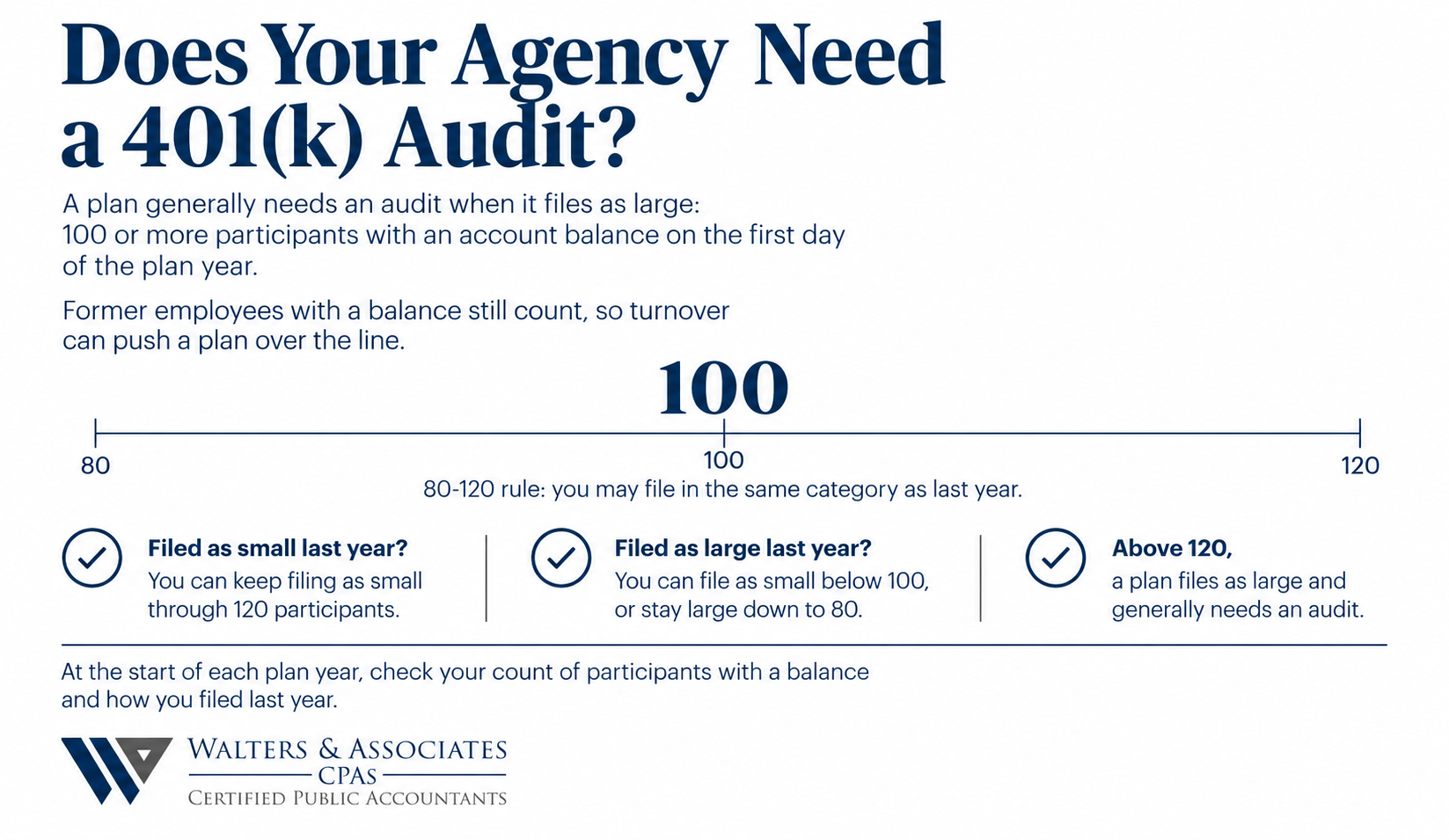
A plan that filed as small last year can keep filing as small through 120 participants. Above 120, it files as large and needs an audit.
A plan that filed as large last year can generally file as small once its count falls below 100. If the count is still 80 or more, the plan can instead elect to keep filing as large. Below 80, it files as small. A plan that files as large is subject to the large plan requirements, including the independent auditor’s report, even when its count is under 100.
What Does a 401(k) Plan Audit Involve?
ERISA Section 103(a)(3)(C) Audit (Formerly Limited Scope) vs. Non-Section 103(a)(3)(C) Audit
When a qualified institution such as a bank or insurance company holds the investments and provides a proper certification, plan management can elect an ERISA Section 103(a)(3)(C) audit (formerly called a limited scope audit) and exclude the certified investment information from the audit. (AICPA Employee Benefit Plan Audit Quality Center, SAS 136 Audit Advisory; DOL, Audit Quality Study). If a valid certification is not available, a non-Section 103(a)(3)(C) audit is performed, and investments are subject to testing. All other balances and transactions are subject to the same audit procedures as those performed in a non-Section 103(a)(3)(C) audit (formerly called a full scope audit).
What Auditors Actually Test
Plan audits focus on areas that are unique to benefit plans. Our plan audits cover:
- eligibility
- payroll and participant data
- calculation of employee and employer contributions
- deferral elections
- participant accounts and allocations
- participant loans
- benefit payments
- timeliness of participant contribution remittances
Common areas of auditor deficiencies, as reported in the DOL’s latest audit quality study, are participant data, contributions, and benefit payments (DOL, Audit Quality Study).
What Happens If You Miss a Required Audit or Form 5500 Deadline?
Unless an extension is filed, a Form 5500 is due by the last day of the seventh month after the plan year ends. For a calendar-year plan, that is July 31, and when a due date falls on a weekend or federal holiday, the filing is due on the next business day (DOL, 2025 Form 5500 Instructions).
The audit must be completed before the Form 5500 filing due date because the audited financial statements are attached to the Form 5500.
Filing IRS Form 5558 on or before the normal due date gives a one-time extension of up to two and a half months, which moves the due date for a calendar-year plan to October 15th.
Failing to file on time and filing an incomplete Form 5500, such as filing without the independent accountant’s audit report, can lead to penalties.
Currently, the DOL can assess up to $2,739 per day under ERISA section 502(c)(2) for failing to file a complete and accurate report, an amount adjusted annually for inflation, and the IRS can assess a fee of up to $250 per day subject to a $150,000 maximum under Code section 6652(e).
How Can the DFVCP Reduce Penalties?
A plan that has already missed a filing still has an option. The DOL’s Delinquent Filer Voluntary Compliance Program (DFVCP) lets a plan administrator file the delinquent annual report and pay a reduced penalty (DOL, DFVC Program). Eligibility is limited to administrators who have not yet been notified of a failure to file, so acting before a DOL notice arrives is what keeps the program available.
How Much Does a 401(k) Plan Audit Cost?
Cost depends on the plan, not just the headcount. Walters & Associates, CPAs prices employee benefit plan audits at a flat rate that depends on plan type, plan size, the assets held, and the plan provisions.
For a closer look at what drives the number, read our guide to 401(k) audit cost.
What to Look for in a 401(k) Plan Auditor
The plan administrator hires the auditor on behalf of the plan’s participants and beneficiaries, so the choice matters. In fact, if you do not select a qualified auditor, you may be subject to penalties.
In its most recent study, the DOL found that 30 percent of the plan audits it reviewed had major deficiencies. It also found that audits performed by members of the AICPA’s Employee Benefit Plan Audit Quality Center had a significantly lower deficiency rate, and that the more plan audits a CPA performs, the better the audit quality tends to be (DOL, Audit Quality Study).
That points to three questions for any auditor:
- Does the firm specialize in benefit plan audits?
- Is the firm a member of the AICPA’s Employee Benefit Plan Audit Quality Center?
- Does the firm understand your industry?
Walters & Associates, CPAs is a member of the AICPA’s Employee Benefit Plan Audit Quality Center. We have a team of professionals devoted to employee benefit plan audits. We know home health and hospice organizations.
The 401(k) plan audit requirement is based on how many participants have a balance on the first day of the plan year and how the plan filed last year.
If your count is approaching the audit requirement or has met the audit requirement, or if you have received a DOL notice about an incomplete filing, talk to a team that audits benefit plans.
Request a free, no-obligation audit consultation with Walters & Associates, CPAs.
Frequently Asked Questions
What triggers a 401(k) plan audit requirement?
Filing as a large plan: 100+ participants with account balances at the start of the plan year, subject to the 80-120 rule.
Does the 80-120 rule mean I don’t need an audit?
Not always. It lets you file in the same category as last year, large or small, if you have 80 to 120 participants.
What is an ERISA Section 103(a)(3)(C) audit (formerly limited scope)?
An audit that excludes investment information a qualified institution certifies; formerly called a limited scope audit.
When is the Form 5500 due for a calendar-year plan?
July 31, or October 15 with a timely Form 5558 extension. Other plan years: last day of the seventh month after year end.
What happens if I miss a required audit or file late?
The DOL can assess penalties for incomplete or late filings. The DFVCP offers reduced penalties if you file before a DOL notice.
How much does a 401(k) plan audit cost?
It depends on plan type, size, assets held, and provisions. Walters & Associates, CPAs offers flat-rate pricing after a free consultation.
Sources